

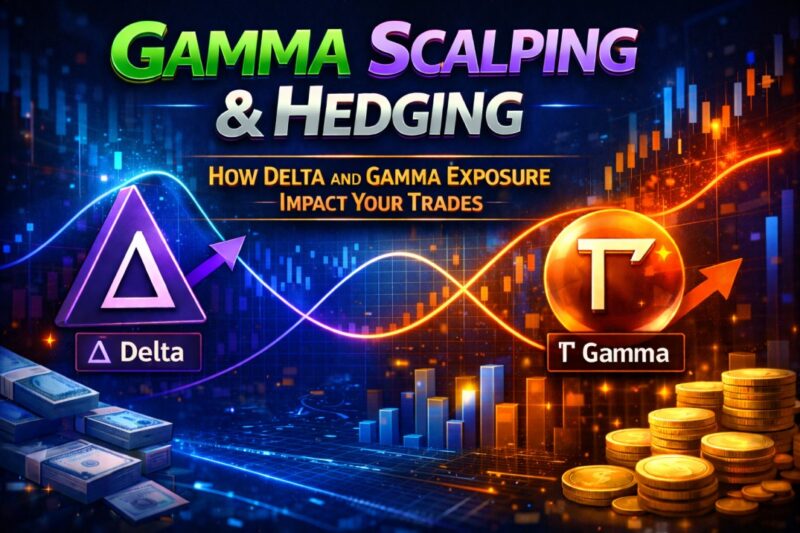
Gamma Scalping and Hedging: How Delta and Gamma Exposure Impact Your Trades
When it comes to trading, many options traders are not concerned about picking the wrong path. But they are more worried about quietly changing risks, and the data proves it.
In India’s big market, around 93% of small traders lost money of over ₹1.8 lakh crore in total. The condition event worsened when around 91% of retail investors lost funds in FY2025 alone, signaling the power of risks in terms of eating up capital.
Everyone who is well-linked to the stock market often hears such things again and again that positions change shape even with normal market behavior. These transformations come from delta and gamma rather than market-impacting news, headlines, or timing.
What Gamma Scalping and Hedging Actually Mean
When you own an options position, the market price moves and changes your risks. Your delta that has been tracking the profit also shifts, because gamma pushes it around.
To remain safe, all you need is to fix your delta to bring the risk back to a neutral level, known as hedging. Gamma scalping is simply doing the same fix over and over with a fluctuating market.
Why Delta and Gamma Change Without New Trades
The major problem with trading is that your risk might be shifting even in still market scenarios. Because of this, even a small price change can move delta on its own. Gamma is behind the force that controls how fast the change happens.
Delta Shows Current Direction Risk
Delta answers a very basic question about the current trade, like if the price moves right now, what impact could it have?
Consider the delta as the risk meter for today, as it shows current exposure. However, it will not clearly tell you what will happen next in the market.
| Delta | What a small price move does |
| +20 | Mild impact |
| +50 | Noticeable impact |
| +80 | Very sensitive |
Gamma Shows How Fast That Risk Grows
Gamma explains why your delta refuses to return to its previous position. Even a small price change will change calm gamma from an aggressive one. While the price change might seem static, your total risk can change with speed.
The sudden change is just gamma doing its work in the background. You can consider it as a speed meter for risk, pushing delta higher or lower as the market moves.
| Price Move | Delta Before | Delta After |
| Small up move | +30 | +45 |
| Another small move | +45 | +65 |
High Gamma Means Faster and Costlier Adjustments
High gamma clearly shows that things happen much faster, allowing you to quickly fix the position. When you have to adjust more often, you’ll end up making more trades placed in the day. It will also cause more slippage to take up your profit and error chances. High gamma doesn’t always mean danger, but paying attention to trade shifting is important.
Low Gamma Can Create False Comfort
Low gamma feels quite easier because of stable risk. Since delta moves hardly, you’ll be in more control. However, a strong market movement can make the delta jump at all.
How Hedging Works in Practice
Hedging is just a temporary reset rather than permanent protection. It fixes the delta to lower exposure now. Once the prices move, the fix begins to fade.
Every Hedge Creates a Trade-Off
| What You Gain | What You Pay |
| Lower delta risk | Execution cost |
| Smoother exposure | Slippage |
| Better control | More decisions |
Volatility Decides If Gamma Scalping Works
Gamma scalping needs price swings as large price movements shift delta. If the price stays flat, your hedging costs will take up your profit. Gamma doesn’t make a profit, but movement does.
Quiet Markets Punish Over-Adjustment
When the market gets slow, the delta moves barely. Traders reacting too much can add up hidden costs, piling up. Even when there is no loss, there is also a gain. Active hedging in flat markets can drain down the account.
Time and Expiry Change the Rules
As expiry comes closer, gamma rises, and delta reacts quickly, leaving very little room for error. Even tiny price movements can now force quick actions.
Short-Dated Options Increase Stress
Short-term options increase speed, pressure, and decision-making chances.
Tools and Technologies Used for Gamma Management
Traders use a few tools, like live Greek views, Delta Alerts, Volatility Tools, etc., to remain aware of delta and react quickly.
Practical Considerations Before Gamma Scalping
| Factor | Why It Matters |
| Position size | Small errors grow fast |
| Liquidity | Adjustments must be easy |
| Execution speed | Delta moves quickly |
Portfolio-Level Gamma Risk
While one trade may seem safe, five similar ones end up adding more risks quickly. The total risk often goes unnoticed until a big move occurs. You need to remain aware to avoid sudden and big losses.
Advanced Gamma Scalping Variations
Some traders only hedge when high volatility or delta is hitting low limits. While others use options instead of stock to change risk and time decay altogether.
Using Options Instead of Stock for Hedging
Using options rather than stocks adds more flexibility. It will change your gamma and theta with no need to constantly rebalance. It will reshape the future risk rather than just fixing today’s delta.
Conclusion
Hence, gamma scalping is not about being smarter than the market. It is agreed that risk changes even with stable market conditions.
Links Used –
For More Information: Download Stockyaari App Now
Standard warning: “Investment in securities market are subject to market risks. Read all the related documents carefully before investing.” Disclaimers: a. “Registration granted by SEBI, enlistment as RA with Exchange and certification from NISM in no way guarantee performance of the intermediary or provide any assurance of returns to investors.” b. “The securities quoted are for illustration only and are not recommendatory.”
This analysis is for informational purposes only. Please consult a SEBI-registered financial advisor before investing.
– Chandan Pathak
Equity Research Analyst, StockYaari