
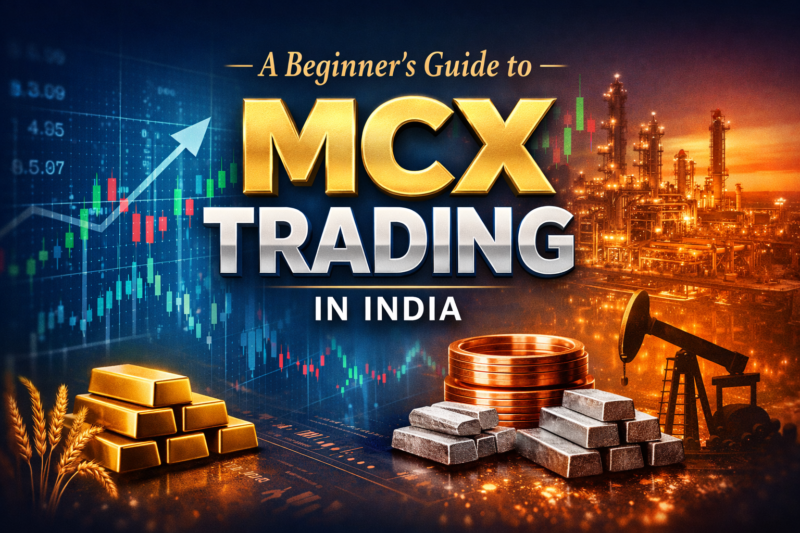
A Beginner’s Guide to MCX Trading in India
If you are familiar with commodity trading, you might have heard about MCX. In earlier times, farmers used to sell their extra produce in local markets with simple agreements. These systems grew increasingly structured and controlled over time.
The Multi Commodity Exchange of India Limited (MCX) is currently one of the main locations in India for structured and transparent commodity trading.
What Is MCX Trading?
The purchase and sale of commodity contracts on the Multi Commodity Exchange is known as ‘MCX trading’. It is overseen by the Securities and Exchange Board of India, or SEBI. In November 2003, it was established.
It operates similarly to stock exchanges like the Bombay Stock Exchange (BSE) and the National Stock Exchange (NSE). The difference is that instead of shares, commodities like gold, crude oil, and agricultural products are traded.
In a nutshell, MCX is an online marketplace that allows sellers to buy and sell goods.
How to Trade on MCX: You may start trading on MCX by following these simple steps.
Step 1: Select a broker
Open a trading account with a commodity broker that is subject to SEBI regulation.
Step 2: Finish the KYC
For verification, send in your photo, PAN card, and Aadhaar.
Step 3: Add money
Make a deposit into your trading account. This covers both your margin and trading amount.
Step 4: Access your account.
To access the trading platform, enter your login credentials.
Step 5: Make a trade
Select the amount, price, and commodity. Next, place your order to buy or sell.
Step 6: Monitor the market
Prior to making judgements, keep an eye on market trends.
Commodities Exchanged on MCX
MCX provides a variety of commodities.
Products from agriculture
Cotton, rice, wheat, soybean oil, and soybean meal
Metals
Nickel, aluminium, copper, and gold
Vitality
Natural gas and crude oil
Soft goods
Coffee and sugar
This diversity enables traders to investigate various choices depending on the state of the market.
Factors That Affect Commodity Prices on MCX
Commodity prices do not stay the same. They change due to many reasons.
Supply and Demand
When there is a dearth of supply and a high demand, prices increase. Prices are also impacted by seasonal variations and worldwide demand.
Geopolitical aspects
Price fluctuations may result from events like wars, trade disputes, or sanctions. For example, gold prices often rise in uncertain times.
Costs of production
Hikes in labour, transportation, or tax-related production costs are usually followed by price hikes.
Technological developments
New innovations increase output even when they initially increase costs. This could have an effect on prices.
The Benefits of MCX Trading
MCX trading has several advantages for investors.
helps keep inflation at bay.
A rise in inflation could increase the value of commodities like gold.
Portfolio diversification
You can reduce the risk of your investments by employing commodities. They don’t necessarily go in the same direction as the stock market.
Excellent liquidity
Buying and selling are made simpler by MCX’s active trading.
System transparency
MCX trading is transparent and safe due to SEBI regulation.
In conclusion
MCX is an online commodity trading platform based in India. After orders are placed, the technique compares the prices quoted by merchants.
It could appear challenging at first. However, you can gradually learn it with a basic comprehension and consistent tracking. MCX trading can be a beneficial aspect of your investing journey if you take the proper strategy.
Frequently Asked Questions
What documents are required to open an MCX account?
You need a PAN card, ID proof, address proof, income proof, and a cancelled cheque.
How does MCX work?
MCX connects buyers and sellers through an online system. Orders are matched based on price and time.
How to purchase MCX shares?
You can buy MCX shares through a broker. You need a demat account and completed KYC.
Who can trade on MCX?
Anyone with a trading account under a SEBI registered broker can trade, if they meet the required conditions.
What is the difference between MCX and NCDEX?
The National Commodity and Derivatives Exchange (NCDEX) mainly deals with agricultural commodities. MCX deals with both agricultural and non agricultural commodities like metals and energy.
For More Information: Download Stockyaari App Now
Standard warning: “Investment in securities market are subject to market risks. Read all the related documents carefully before investing.” Disclaimers: a. “Registration granted by SEBI, enlistment as RA with Exchange and certification from NISM in no way guarantee performance of the intermediary or provide any assurance of returns to investors.” b. “The securities quoted are for illustration only and are not recommendatory.”
This analysis is for informational purposes only. Please consult a SEBI-registered financial advisor before investing.
– Chandan Pathak
Equity Research Analyst, StockYaari